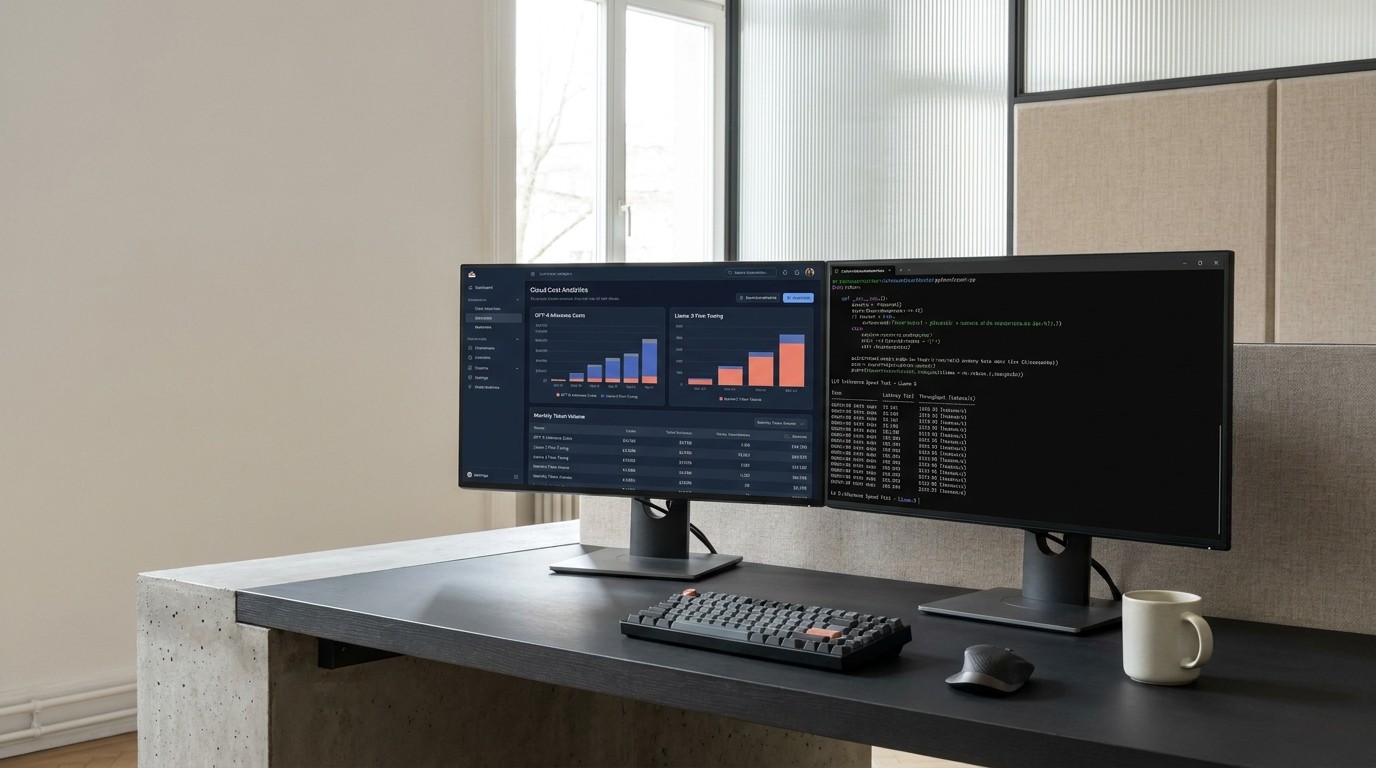
Why Token Costs Are Only Part of the Custom RAG System Cost
For e-commerce CTOs, deploying a bespoke Retrieval-Augmented Generation system for customer support is a significant strategic investment.
While initial budget discussions often focus on LLM token fees, that narrow view can create serious budget gaps.
A complete understanding of the total custom RAG system cost is essential for project viability.
The true operational expense extends far beyond tokens. Failing to account for vector database hosting, embedding generation, and GPU inference can create significant budget overruns and undermine ROI.
This guide breaks down the full financial picture needed to build a sustainable AI solution.
Why Do Token Costs Obscure the Full Financial Picture?
LLM API providers have made pricing simple: you pay for the tokens you use for input and output.
This model is attractive because it feels clear and predictable during early testing.
However, it creates a blind spot.
In a production RAG system, the LLM call is only the final step in a complex, resource-intensive pipeline.
The infrastructure that enables that final call, from data processing to vector retrieval, represents a large hidden cost base.
Thinking only about tokens is like budgeting for a factory by calculating only the electricity cost of the final assembly line while ignoring the building, machinery, and raw material logistics.
What Are the Hidden Infrastructure Costs of a Custom RAG System?
To budget accurately, you need to analyze the entire inference pipeline.
The major operational expenses are not only in the LLM itself, but also in the systems that feed it the right information at the right time.
These recurring costs are directly tied to your data volume, query load, and performance requirements.
Vector Database Hosting and Operations
Your RAG system’s knowledge lives in a vector database.
This specialized database stores embeddings, which are numerical representations of your product catalog, FAQs, and support documentation.
Every customer query requires searching this database to find the most relevant context.
This constant storing, indexing, and querying creates significant operational costs.
Key cost factors include:
The volume of data stored
The indexing strategy used for retrieval
The number of concurrent queries your support system must handle
The performance tier required for low-latency responses
For example, a mid-sized e-commerce operation handling 500,000 customer inquiries monthly could see vector database costs alone range from $1,500 to $5,000 per month, depending on the provider and performance tier.
Embedding Generation and Continuous Refresh Cycles
Before data can be stored in a vector database, it must be converted into embeddings using an embedding model.
This is not only a one-time cost.
There is an initial expense for processing the full existing knowledge base, but the real recurring cost comes from keeping that knowledge base current.
For an e-commerce business, this means generating new embeddings whenever:
A product is added
A product description is updated
A new policy is published
A new customer issue is documented
Support content changes
For a product catalog of 1 million items, initial embedding generation can incur thousands of dollars in API fees or require significant dedicated compute time.
Daily or weekly updates create a continuous operational expense that must be included in the total custom RAG system cost.
GPU Inference and Compute Infrastructure
Even if you use a third-party API for your primary LLM, the embedding model and retrieval logic may still require dedicated compute resources for optimal performance.
Real-time customer support cannot tolerate high latency.
To achieve the required speed, especially during peak traffic events like Black Friday, you may need dedicated GPU instances.
These resources are expensive to provision and maintain.
The cost scales with:
The complexity of your selected models
The volume of incoming queries
Your latency requirements
Peak traffic patterns
Relying only on general-purpose CPUs can create bottlenecks that degrade the user experience and reduce the value of the AI-powered support system.
How Can Engineering Decisions Reduce Hidden Costs?
Understanding the costs is only the first step.
The next step is actively managing them through smart engineering decisions.
The architecture of your RAG system is not just a technical blueprint. It is also a financial blueprint.
Every decision, from model selection to data batching, has a direct impact on your monthly cloud bill.
Strategic Model and Infrastructure Selection
The choice of embedding model is a critical cost lever.
State-of-the-art models may offer marginal performance gains at a substantially higher computational cost.
An experienced engineering team can benchmark open-source and proprietary models to find the right balance between performance and efficiency for your specific use case.
The same applies to vector database selection.
Choosing between a managed service and a self-hosted solution, then configuring the right indexing strategy, can lead to major cost savings.
Indexing strategy directly affects memory usage and query latency, both of which are key drivers of operational cost.
Optimizing Data Pipelines and Retrieval
Many efficiency gains come from the fine details of the data pipeline.
Cost can be reduced by optimizing:
How documents are batched for embedding
How metadata is structured for filtering
How queries are formulated for the vector database
How often embeddings are refreshed
How retrieval results are ranked and cached
For example, one e-commerce client reduced RAG inference costs by 30% after reevaluating the embedding model and optimizing retrieval batching.
This shows how fine-grained engineering decisions can directly impact the bottom line.
It also explains why specialized AI engineering talent is often essential for building cost-efficient RAG systems.
A Realistic Budget Framework for Custom RAG
A realistic budget for a custom RAG system in e-commerce must go beyond token costs.
Your financial model should include the following categories.
LLM API Costs
The variable cost per customer query based on input and output tokens.
Vector Database Costs
Monthly recurring costs for storage, indexing, querying, and performance tiers.
Embedding Compute Costs
The cost of generating embeddings during initial setup and ongoing knowledge base refreshes.
Inference Infrastructure Costs
The cost of GPUs or specialized compute needed for low-latency retrieval and model execution.
Engineering and Maintenance
The cost of the team required to build, monitor, optimize, and troubleshoot the system.
Security and Governance
The cost of protecting customer data, managing access controls, monitoring usage, and ensuring system reliability.
Final Takeaway
A custom RAG system can be a powerful customer support asset for e-commerce businesses.
But its true cost is not captured by token pricing alone.
Vector databases, embedding generation, GPU inference, infrastructure hosting, and ongoing engineering support all shape the actual total cost of ownership.
By viewing the system holistically, CTOs can make better trade-offs, avoid budget overruns, and build an AI customer support solution that is both high-performing and financially sustainable.
Understanding the complete custom RAG system cost is essential for accurate ROI modeling and long-term stakeholder buy-in.
About author
Marcus leads AI strategy and client advisory at Agintex, helping businesses translate complex AI opportunities into clear, executable plans. He writes about AI adoption, technology leadership, and the decisions that separate companies that scale from those that stall.

Marcus Reid
Head of Strategy
Subscribe to our newsletter
Sign up to get the most recent blog articles in your email every week.