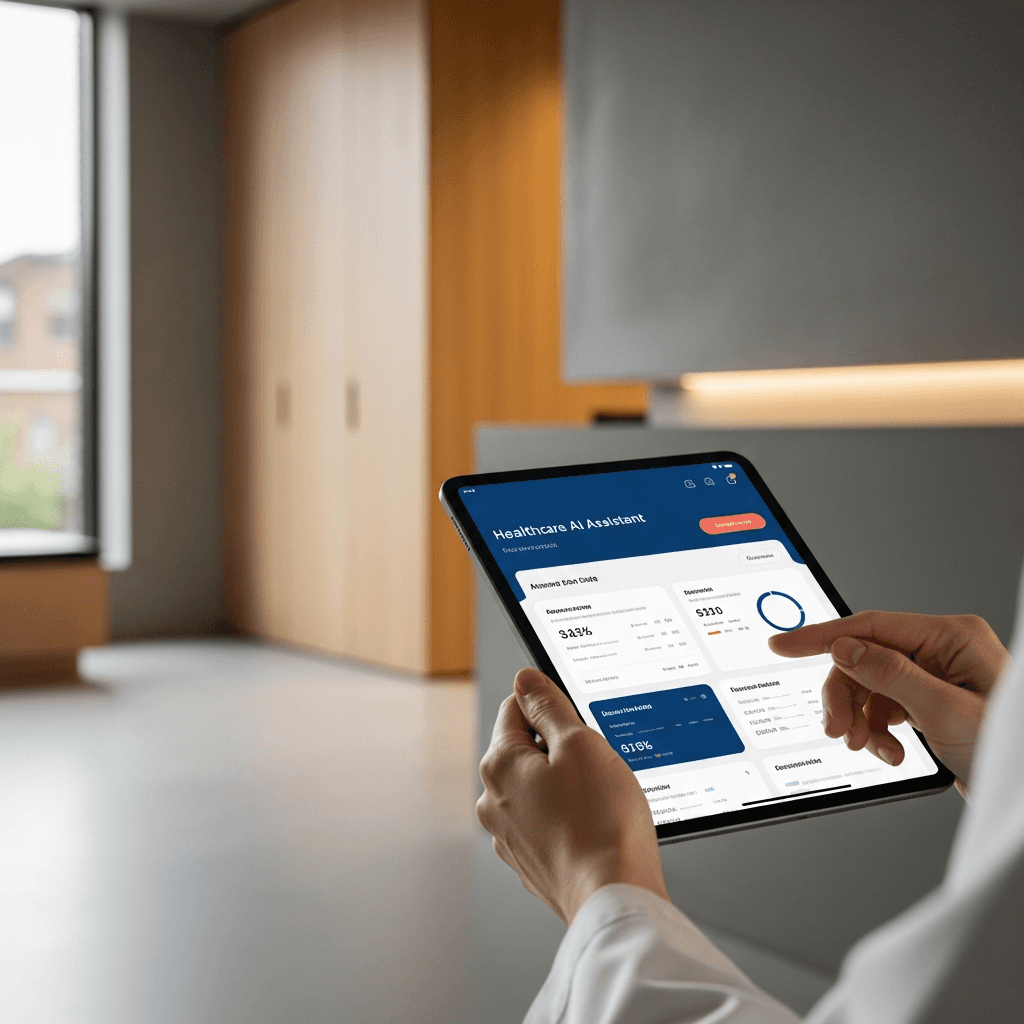
The Challenge: An AI Assistant MVP Facing a Compliance Wall
For founders of funded B2B healthcare SaaS startups, the path from AI concept to market-ready product is filled with regulatory hurdles.
One healthcare SaaS company faced this exact challenge.
They had a working MVP for an AI assistant, but its reliance on a general-purpose LLM created serious compliance and accuracy risks.
To move forward, they needed to transform the prototype into a tool that was powerful, secure, and verifiably safe for clinical use.
The thesis is clear:
Transforming an AI MVP into a secure, adopted, and compliant healthcare tool requires two things:
• A verifiable RAG architecture
• A custom user interface designed for real clinical workflows
Without both, even a powerful AI assistant can become a liability.
Key Obstacles
The startup faced several major challenges.
Regulatory Risk
The MVP lacked the necessary guardrails for HIPAA compliance.
Any interaction with Protected Health Information created risk for the company and its future healthcare clients.
Accuracy and Hallucination
The base LLM was fluent, but it was prone to hallucination.
In healthcare, an inaccurate or fabricated response is not just a product issue. It can become a patient safety risk.
The system needed to be grounded in factual, verifiable clinical data.
Poor Workflow Integration
The generic UI was clunky and did not match how doctors and nurses actually work.
Instead of feeling like a helpful shortcut, it felt like an extra step.
That created adoption risk from the beginning.
Scalability Concerns
The original approach could not scale across different EHR systems or the siloed data structures common in healthcare organizations.
Strategic Approach: Verifiability and Usability
Instead of patching the existing MVP, the better path was a foundational rebuild.
The strategy focused on two principles:
• Verifiability
• Usability
The goal was to create an AI assistant that was not only intelligent, but also trustworthy, compliant, and easy for clinicians to use.
Prioritizing Accuracy with RAG
The first priority was solving hallucination and data privacy risk.
A general-purpose LLM is not suitable for querying private clinical information on its own.
The solution was a secure RAG architecture.
RAG anchors the LLM to a specific, curated, and protected knowledge base.
In this case, that knowledge base included:
• Anonymized EHR data
• Clinical guidelines
• Internal protocols
• HIPAA-compliant data stores
When a clinician asks a question, the system first retrieves relevant documents from the private database.
The LLM then generates an answer based only on those retrieved documents.
This approach helps deliver responses that are:
• Traceable
• Accurate
• Context-aware
• Grounded in approved data
• Safer for clinical use
Designing a Custom UI for Clinical Workflows
An AI tool clinicians do not use has no value.
User adoption depended on building an interface that felt like a natural extension of existing tools.
The team worked directly with healthcare professionals to understand how they searched for:
• Patient histories
• Lab results
• Treatment notes
• Clinical documentation
• Relevant care context
That workflow research shaped a custom UI focused on speed, clarity, and ease of use.
The interface was designed to surface critical information quickly, reduce clicks, and present complex clinical data in a digestible format.
Implementation: Secure RAG and Custom UI
The implementation followed three parallel workstreams:
• Building the secure data pipeline
• Engineering the front-end experience
• Embedding compliance across the stack
Building the Secure RAG Pipeline
The team began by provisioning a HIPAA-compliant cloud environment with strict access controls.
Then they built a secure ingestion pipeline to process and index data from:
• Legacy EHR exports
• Internal knowledge bases
• Clinical documents
• Approved healthcare data sources
Each piece of information was vectorized and stored in a secure vector database.
The retrieval algorithm was tuned to understand clinical queries, such as:
• Patient medication history
• Latest lab results
• Treatment notes
• Relevant clinical context
The LLM interacted with this data through a private endpoint, ensuring PHI stayed within the secure environment.
Engineering a Workflow-Centric User Interface
The front-end team developed a custom UI based on workflow analysis and high-fidelity mockups.
The interface included:
• A natural language search bar
• Clean result cards
• Source-linked responses
• Query history
• Pinned findings for patient charts
• One-click access to referenced documents
The source-linking feature was especially important.
It showed clinicians exactly where the AI found its information, helping build trust and supporting clinical validation.
Ensuring End-to-End HIPAA Compliance
Compliance was not treated as a final checklist item.
It was built into the system from the start.
Key safeguards included:
• End-to-end encryption
• Encryption for data in transit and at rest
• Role-based access controls
• Comprehensive audit logs
• Query tracking
• Data access monitoring
• Secure infrastructure design
Every query and data access event was logged, making the product defensible during healthcare security reviews.
Results of Moving Beyond the MVP
The rebuilt AI assistant helped the startup move from a risky prototype to a market-ready healthcare product.
Faster Clinical Data Retrieval
Clinicians previously spent several minutes navigating complex EHR interfaces to piece together patient information.
With the AI assistant, they could ask direct questions and receive source-verified summaries in seconds.
This reduced administrative burden and helped medical staff focus more time on patient care.
Stronger Trust and Adoption
The custom UI and reliable RAG architecture helped drive adoption.
Because the tool was intuitive and provided accurate, traceable answers, it became easier for clinicians to trust and use in daily workflows.
The startup also saw stronger user engagement and faster onboarding for new medical staff.
A Clearer Path to Market
The project de-risked the startup’s product roadmap.
They now had a secure, compliant, and differentiated AI feature that could support enterprise healthcare sales.
The compliant AI assistant became a key part of their go-to-market strategy and helped accelerate product-market fit in a highly regulated market.
Key Takeaways for Healthcare SaaS Founders
RAG Is Essential for Trust and Compliance
For applications involving private or sensitive healthcare data, relying on a generic LLM is not enough.
A well-designed RAG architecture is critical for accurate, verifiable, and secure responses.
User Experience Matters as Much as the Model
Even the best AI model can fail if the interface does not match real user workflows.
Healthcare AI tools must reduce friction, not add more steps.
Compliance Must Be Designed from Day One
Retrofitting security and compliance into a finished product is difficult and expensive.
The strongest approach is to build with HIPAA and clinical safety requirements from the first line of code.
The Strategic Takeaway
Building a compliant AI assistant for healthcare is possible, but it requires the right architecture.
The winning combination is:
• Secure RAG backend
• Verifiable source retrieval
• HIPAA-aligned infrastructure
• Custom clinical UI
• Strong workflow integration
• Audit-ready controls
For healthcare SaaS startups, this approach can turn a risky AI MVP into a trusted, compliant, and market-ready product.
About author
Tobias oversees software, product engineering, and connected systems at Agintex. He writes about technical architecture, IoT integration, UI/UX engineering, and what it actually takes to ship a product that works at scale.

Tobias Lane
Head of Engineering
Subscribe to our newsletter
Sign up to get the most recent blog articles in your email every week.


