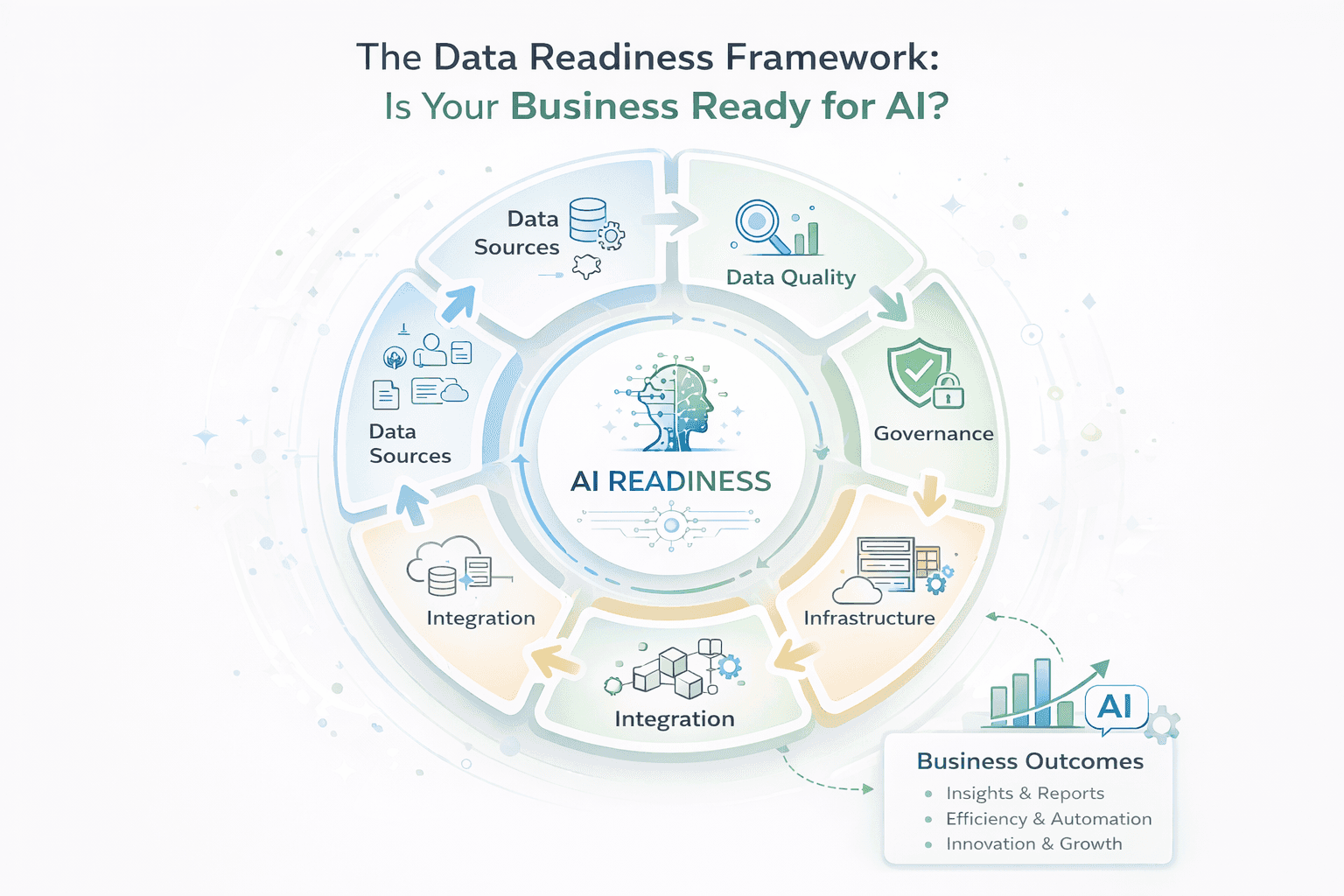
The four levels of data readiness
Level 1: Collecting. You are capturing data, but it is siloed across multiple systems, inconsistent in format, and not accessible without manual effort. Most businesses are here.
Level 2: Accessible. Data is stored in a central location and can be queried. Quality is inconsistent but the infrastructure exists.
Level 3: Reliable. Data is clean, consistent, and governed. Pipelines are automated. Quality is monitored. You can trust the data you use for decisions.
Level 4: AI-Ready. Data flows automatically to where it needs to be, in the format required by your AI and ML systems, in real time or batch as needed. Quality monitoring is automated. New data sources can be added without disrupting existing pipelines.
"Most AI projects need Level 3 data readiness at minimum. Trying to build AI on Level 1 or Level 2 data is the primary reason projects stall."
How to assess your current level
Ask your team these questions. Can you run a query across all your customer data in one place without manual preparation? When data quality issues occur, who finds them and how quickly? How long does it take to get data from a new source into your analytics environment? Do you have automated alerts when data quality drops?
The answers place you clearly on the readiness scale.
Moving from Level 1 to Level 3
The fastest path from Level 1 to Level 3 involves three initiatives running in parallel: centralizing data into a single warehouse or lake, building automated pipelines to replace manual data movement, and implementing data quality monitoring.
This is exactly what Agintex's data engineering practice does. If you want to assess your current data readiness and build a roadmap for getting AI-ready, book a data strategy call.
About author
Nadia leads data engineering and machine learning at Agintex. She writes about the data infrastructure, IoT data pipelines, and ML practices that make AI systems reliable, accurate, and production-ready.

Nadia Osei
Data and ML Lead
Subscribe to our newsletter
Sign up to get the most recent blog articles in your email every week.