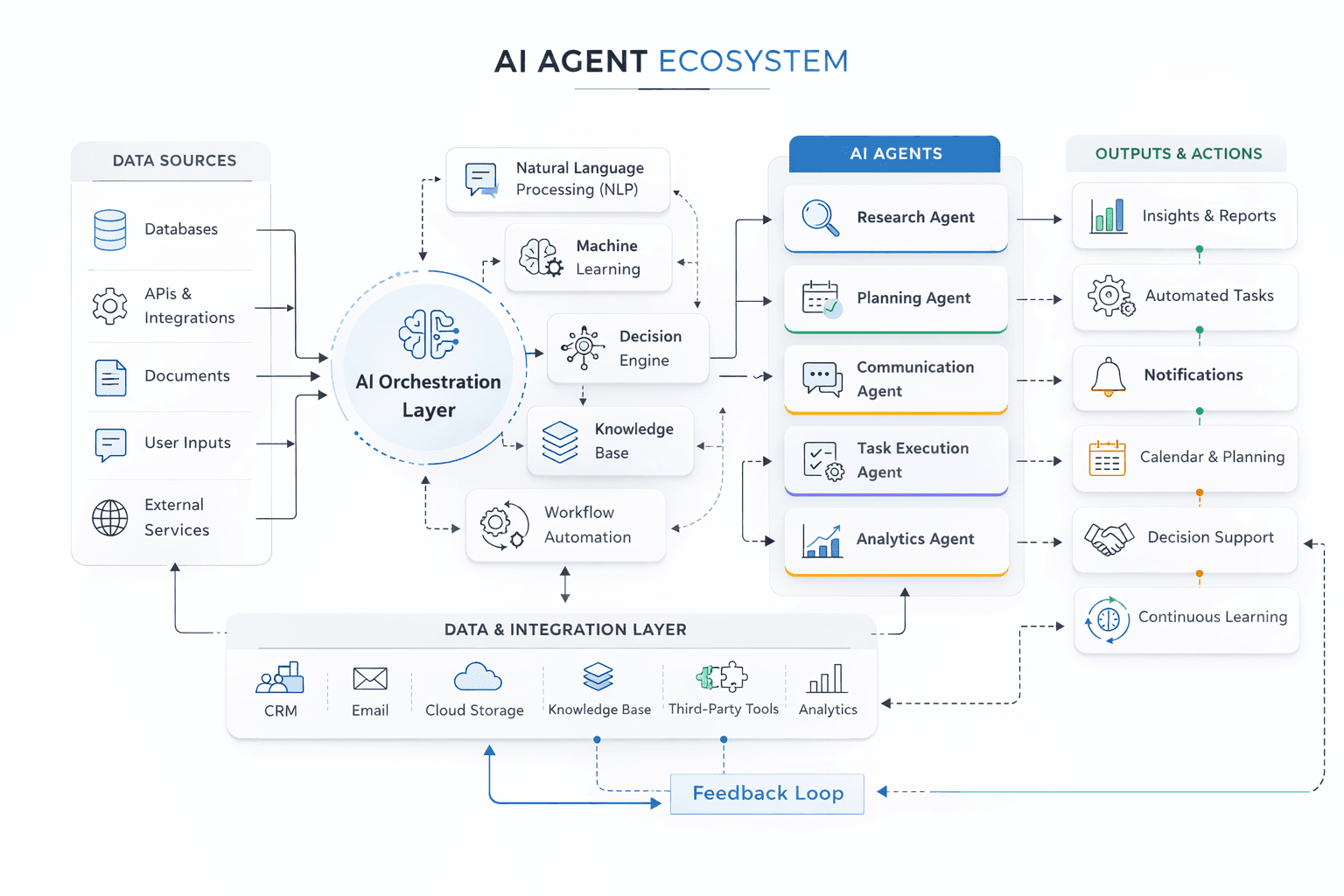
The four components of every AI agent system
Every AI agent system, regardless of complexity, has four core components. Understanding these four things gives you enough context to ask the right questions and evaluate the answers you get.
The model is the AI brain. It receives instructions and context, reasons about them, and decides what to do next. The tools are the capabilities the agent uses to interact with the world: searching the web, reading files, calling APIs, writing to databases. The memory determines what context the agent retains between steps and between sessions. The orchestrator manages what happens when, especially in multi-agent systems where multiple agents are working in parallel.
How a single agent works step by step
When an agent receives an instruction, it first reasons about what the instruction requires. It then identifies which tools it needs and in what sequence. It executes those tools, reads the results, reasons about whether they are sufficient, and either continues or completes the task.
This loop of reason, act, observe, reason is the core of how every agent works. Understanding this loop helps you evaluate whether an agent is being used appropriately for a given task.
The questions to ask about any agent proposal
What model is the agent using, and why is that model the right choice for this use case?
What tools does the agent have access to, and what safeguards are in place to prevent it from taking actions it should not?
How is memory managed? What does the agent remember between sessions, and how is that data stored and protected?
How is the agent evaluated? What happens when it makes a mistake?
What does the monitoring and alerting setup look like after deployment?
"A technical team that cannot answer these questions clearly probably has not thought about them carefully enough."
Common architecture mistakes to watch out for
Too much autonomy too early: agents should start with limited tool access and human review steps. Expand autonomy gradually as you build confidence in performance.
No evaluation framework: an agent that ships without a structured evaluation suite is a system you cannot improve systematically.
Missing memory design: agents that do not handle memory correctly either repeat themselves, forget critical context, or consume unnecessary tokens.
No rollback plan: any production AI system needs a clear plan for what happens when it fails or behaves unexpectedly.
About author
Jada leads AI Solutions at Agintex, working directly with clients to scope, architect, and deliver AI agent and ML systems. She writes about practical AI deployment for business leaders who need results, not theory.

Jada Mercer
AI Solutions Lead
Subscribe to our newsletter
Sign up to get the most recent blog articles in your email every week.